 |
|
|
|
|
|
|
|
|
|
|
|
|
|
|
|
|
|
|
|
|
|
|
|
|
|
|
|
|
|
|
|
|
|
|
|
|
|
|
|
|
|
|
|
|
|
|
|
|
|
|
|
|
|
|
|
|
|
|
|
|
|
|
|
|
|
|
|
|
|
|
 |
|
|
|
|
 |
|
 |
|
|
|
|
|
|
|
|
|
|
|
|
|
|
|
|
 |
|
|
|
|
|
|
|
 |
|
|
|
|
|
|
|
|
|
|
|
This 2022 photo shows the Nice-Middleton Bridge (US 301) looking south above the Maryland shoreline. The new bridge was four months away from completion in this photo. (Photo by Dan Murphy.)
|
|
|
|
|
|
|
|
|
 |
|
|
|
|
 |
|
|
|
|
|
|
|
|
Original span
Type of bridge:
Construction started:
Opened to traffic:
Length of main span:
Length of two auxiliary spans (each)
Total number of spans:
Total length:
Clearance at center above mean high water:
Width of bridge:
Number of traffic lanes:
Steel used on structure:
Cost of original structure:
|
|
|
|
|
|
|
|
|
Steel girder and cantilever truss bridge
December 27, 1938
December 14, 1940
800 feet (244 meters)
366 feet, 8 inches (112 meters)
95 spans
11,446 feet (3,489 meters)
135 feet (41 meters)
27.9 feet (8.5 meters)
2 lanes
11,500 tons (10,433 metric tons)
$5,250,000
|
|
|
|
|
|
|
|
|
|
|
|
|
|
|
|
New span
Type of bridge:
Construction started:
Opened to traffic:
Length of main span:
Length of two auxiliary spans (each):
Total number of spans:
Total length:
Clearance at center above mean high water:
Width of bridge:
Number of traffic lanes:
Cost of original structure:
|
|
|
|
|
|
|
|
|
Concrete-and-steel girder
July 21, 2020
October 12, 2022
350 feet (106.7 meters)
285 feet (86.9 meters)
59 spans
9,966 feet (3,038 meters)
135 feet (41 meters)
61 feet (18.6 meters)
4 lanes
$463,000,000
|
|
|
|
|
|
|
|
|
 |
|
|
|
|
|
|
|
|
Passenger car toll (southbound only):
Maryland EZ-Pass
Out-of-state EZ-Pass
Video toll
|
|
|
|
|
|
|
|
|
|
|
|
|
|
|
|
|
|
|
|
|
|
REPLACING A COLONIAL FERRY ROUTE: The crossing between Newburg, Maryland and Dahlgren (formerly Ludlow's Ferry, or Laidlow's Ferry), Virginia has roots that extend into the colonial era. As early as the mid-18th century, Maryland had established a network of ferries under colonial, and later, early state legislation. While specific early records for Ludlow's Ferry are limited, comparable crossings elsewhere on the Potomac were in operation by this period, suggesting that a ferry at Newburg and Ludlow's Ferry was established as part of this broader transportation network.
EARLY PLANS FOR A HIGHWAY BRIDGE: Plans for a bridge at the Ludlow's Ferry location date back to 1916, when the Potomac and Baltimore Railway proposed a railroad bridge as part of a plan to build a shorter rail line between Baltimore and Newport News, Virginia. The rise of the automobile in the 1920s led to plans for a combined rail-and-road bridge, but nothing came of this proposal, as opposition from steamship companies was too powerful to mount a successful campaign for a new bridge.
The first serious plans for a bridge at this location came in the early 1930s. In February 1933, Maryland Delegate Kent Mullikin introduced legislation authorizing construction of a "Potomac River Bridge," as reported in The Washington Post. The proposal emerged during a period of great economic uncertainty, with state officials exploring infrastructure investments amid widespread bank closures and the broader impacts of the Great Depression.
By mid-1933, plans for the proposed Potomac River Bridge - which also was referred to as the "Morgantown Bridge" in early accounts -had advanced quickly beyond initial legislation to include detailed financial proposals. In June 1933, The Washington Post reported that Maryland officials had sought $3.35 million in federal public works funding for the project, with proponents projecting approximately $343,000 in annual toll revenue. The request, presented at a hearing before Representative Stephen W. Gambrill, reflected the growing role of federal infrastructure spending during the Great Depression. However, the transition from private financing to public funding, even with the support of Governor Harry W. Nice, did not guarantee an immediate start to the project.
|
|
|
|
|
|
|
|
|
|
|
|
|
|
Plans for the Potomac River Bridge were revived in 1938 when the State Roads Commission (SRC) advanced a "Primary Bridge Program" that called for new fixed crossings for the Potomac River, Susquehanna River, and Chesapeake Bay. The Potomac River Bridge was not conceived as an isolated project, but rather as part of Maryland's broader effort to improve major water crossings throughout the state. Contemporary accounts in The Washington Post described the project as part of a broader bypass of Baltimore and Washington, linking the Northeast states and Virginia and points south. Anticipating an increase in traffic to the new span, the SRC extended the existing Route 3 (now US 301) south to the bridgehead in Newburg.
|
|
|
|
|
|
|
|
|
|
|
|
|
|
|
|
|
|
THE ROOSEVELT ADMINISTRATION STEPS IN: The state's Primary Bridge Program won the support of President Franklin D. Roosevelt, who made his initial visit to the bridge site on September 4, 1938. The Public Works Administration (PWA), a federally-run New Deal program started by President Roosevelt, was to pay 45% of the bridge's construction cost - initially estimated at $3.9 million - with the state financing the remaining 55% of the cost through revenue bonds. There was one condition for federal support: that the bridge had to meet War Department requirements for main channel span width and vertical clearance. These changes added about $800,000 to the cost of the bridge.
A ceremonial groundbreaking took place in November 1938, but that month, the PWA threatened to withdraw its support for the bridge if the SRC did not start construction by January 1, 1939. After clearing plans with the New York office of the PWA, and advertised bids for two weeks, the SRC declared to the PWA that it would be able to meet the deadline. Construction of the bridge began on December 27, 1938, just five days before the deadline.
|
|
|
|
|
|
|
|
|
|
|
|
|
|
|
 |
|
|
|
|
|
|
|
|
|
|
|
|
|
|
|
|
|
|
PLANNING AND DESIGN: The J.E. Greiner Company, a Maryland-based bridge design company which oversaw many of the state's large engineering projects, was tasked with designing the Potomac River Bridge. Harris Structural Steel, a New Jersey-based manufacturing company, and Merritt-Chapman & Scott, a New York-based underwater construction firm, were commissioned with building the new bridge.
The original span featured a main 800-foot (244-meter)-long cantilever span, flanked by two side spans each measuring 366 feet, 8 inches (112 meters) long. The main span had a vertical clearance of 700 feet (213 meters) and a horizontal clearance over mean high water of 135 feet (41 meters). Flanking the main and side cantilever spans were 12 deck truss spans and 60 multi-girder beam spans on the Virginia approach, and 10 deck truss spans on the Maryland approach.
THE "POTOMAC PIER": Herschel Allen, a partner at J.E. Greiner, developed the "Potomac Pier" for the project. The "Potomac Pier" eliminated the need for a cofferdam by placing a steel form on the floor of the river and then driving piles through the form. Additional piles were attached and covered with concrete until the pier was fully formed.
CONSTRUCTION GETS UNDERWAY: By the spring of 1939, construction was well underway on both sides of the Potomac. To build the main piers and supports for the approach spans, the lead contractor, Merritt-Chapman & Scott, had the two largest pile drivers ever built for the project. The total weight of each pile driver hammer was 15 tons (13.6 metric tons), each delivering an impact of 36,000 foot-pounds (48,800 joules) at a rate of 55 blows per minute. The massive pile drivers were needed to sink the steel piles as deep as 215 feet (65 feet) to gain traction in the bedrock beneath the deep silt of the Potomac.
The first structural steel sections were erected in the fall of 1939. Prefabricated bridge segments were shipped by rail to Pope's Creek in Charles County, which provided the closest railroad access to the construction site. From this location, these segments were transferred by barge and shipped three miles (five kilometers) south to the bridge site. Concrete forms and other bridge components were also transported downriver to the construction site. On both sides of the span, workers began grading the Maryland and Virginia approaches.
THE BRIDGE OPENS: The Potomac River Bridge was opened to traffic on December 14, 1940, nearly six months behind schedule, at a cost of $5.25 million. When the bridge opened, an improved four-lane highway - an expanded Crain Highway - was completed on the Maryland side from Glen Burnie in Anne Arundel County south to the bridge approach. Similar improvements in Virginia were not completed until after the bridge was completed. Nevertheless, the combined route through Maryland and Virginia received the US 301 designation upon completion of the Potomac River Bridge.
AN AMBITIOUS, BUT UNFULFILLED TOLL OUTLOOK: The Potomac River Bridge was built with the expectation that toll revenues - starting at 75 cents for each passenger car - would rapidly retire construction debt, reflecting the broader optimism surrounding self-supporting toll infrastructure during the New Deal era. Contemporary reports projected that the Potomac River Bridge could repay its construction costs within 12 to 15 years through toll revenues alone. During the first year of operation, officials estimated about 136,000 vehicles crossed the bridge. The explosion of automobile travel after World War II prompted a more than threefold increase to 453,900 total vehicles in 1946, and by 1964, annual traffic peaked at 3.2 million vehicles. Despite the increased traffic, tolls were never removed from the span.
The completion of the Capital Beltway (I-95 and I-495) in 1964 resulted in a one-third reduction in the number of vehicles crossing the Potomac River Bridge as the Capital Beltway, in conjunction with I-95, provided a new high-speed bypass of the Washington, DC area without traffic lights, which the US 301 corridor was unable to provide.
HONORING A BRIDGE BOOSTER: In 1967, the Potomac River Bridge was renamed the Governor Harry W. Nice Memorial Bridge, in honor of the Maryland governor who provided key support for the bridge. Governor Nice died just two months after the bridge was opened to traffic.
|
|
|
|
|
|
|
|
|
|
|
|
|
|
|
 |
|
|
|
|
|
|
|
|
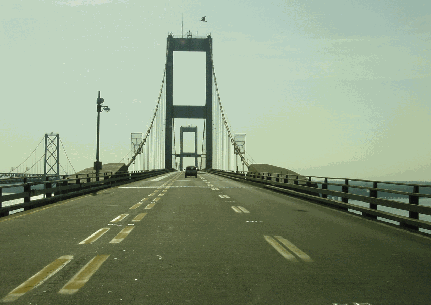
This 2004 photo shows the Nice-Middleton Bridge (US 301) over the Potomac River. This is the only MdTA crossing to connect two states. (Photo from University of Maryland-Bridge Engineering Software and Technology Center, www.best.umd.edu.)
|
|
|
|
|
|
|
|
|
 |
|
|
|
|
|
|
|
|
|
|
|
|
|
|
|
|
|
|
A NEW LEASE ON LIFE: By the mid-1980s, the Nice Bridge had regained the traffic it had lost after the Capital Beltway opened and then some: at the time, it had carried 3.6 million vehicles per year. However, the Nice Bridge had deteriorated to the point that major structural rehabilitation was needed. In 1984, the Maryland Transportation Authority (MdTA) began a two-year, $17.5 million project involving complete rehabilitation of the bridge deck and strengthening of key superstructure elements. It was the first major rehabilitation project since the bridge opened in 1940.
According to Gary A. Smith, the Executive Secretary to the MdTA, the roadway's service life was "near zero" after decades of near-continuous patching and maintenance work. During construction, the bridge operated at one-third of capacity as it was opened only one lane at a time, and motorists had to wait as much as 45 minutes due to alternating one-way traffic patterns. The bridge was also closed overnight Saturdays to allow for replacement of the beam span sections on the Virginia side of the bridge.
Although the rehabilitation extended the useful life of the Nice Bridge, it did not address the bridge's underlying functional limitations, including its narrow two-lane configuration and lack of shoulders. Moreover, the severe traffic disruptions experienced during construction underscored the vulnerability of relying on a two-lane bridge for a growing regional corridor.
PART OF AN EASTERN BYPASS? Soon after the rehabilitation project was completed in 1986, officials began discussions on building a second span at the Nice Bridge site. Although there were few details on whether the proposal would have involved a parallel two-lane span or a new four-lane span, The Washington Post reported that the proposed span would cost approximately $242 million, with another $54 million required for approach improvements
Discussions were also underway at the time to incorporate not only the Nice Bridge, but also the entire US 301-MD 3 corridor through Virginia and Maryland, as part of a $1 billion eastern bypass of the Washington, DC area to relieve growing congestion on the Capital Beltway, particularly along the southern leg near the aging Woodrow Wilson Bridge. Neil J. Pedersen, director of the Maryland Department of Transportation (DOT)'s office of planning and preliminary engineering, appeared to favor an eastern bypass over a competing bypass plan west of Washington, citing the potential ease with which US 301 could be converted into an Interstate-grade highway. However, Pedersen acknowledged at the time that it would take at least another decade before construction could begin.
The state revisited the US 301 Eastern Bypass plan in 1999 as a proposed $1.8 billion six-to-eight-lane freeway extending south from I-595 / US 50 (John Hanson Highway) in Prince Georges County south to the Nice Bridge. The plan, which was detailed in a "US 301 Access Control Study", called for a new US 301 alignment through Prince George's County slightly east of the existing alignment, as well as new interchanges at MD 197, MD 214, MD 725 / MD 202, and MD 4. Plans for the upgraded US 301 were less detailed through Charles County, though the scale of the proposed improvements suggests that a replacement Nice Bridge may ultimately have been required rather than further upgrades to the existing span. However, concerns about the negative impacts of growth on wetlands, parks, and agriculture in southern Maryland ultimately thwarted the project in the early 2000s.
The reconstruction of the Woodrow Wilson Bridge in the 2000s substantially improved traffic flow along the southern leg of the Capital Beltway, reducing the immediate need for a large-scale bypass east of Washington. Moreover, a study at the time found that only 10% of traffic on the Capital Beltway was through, long-distance traffic, further undermining the case for the eastern bypass. While the concept of a US 301 bypass corridor resurfaces periodically, the strategic urgency that existed during the 1980s and 1990s has diminished considerably. Nevertheless, concerns regarding the aging Nice Bridge and its operational deficiencies remained.
|
|
|
|
|
|
|
|
|
|
|
|
|
|
|
 |
|
|
|
|
|
|
|
|
This 2021 photo shows pile construction well underway at the new Nice-Middleton Bridge. On the left, the first of the girders are being placed by construction crews. (Photo by Maryland Transportation Authority.)
|
|
|
|
|
|
|
|
|
|
|
|
|
|
|
|
|
|
TIME FOR A NEW BRIDGE: By the mid-2000s, attention had shifted from rehabilitating the existing Nice Bridge to determining its long-term replacement strategy. In 2006, the MdTA initiated a study to explore upgrading or replacing the bridge. The following year, the MdTA identified six alternative proposals that would expand the crossing from two lanes to four, including options for a two-lane parallel span or a complete replacement of the aging structure with a new four-lane span.
In 2012, the MdTA identified a preferred alternative that would build a new four-lane span just north of the existing bridge that was to include a bicycle / pedestrian path. The agency estimated that the project would cost as much as $850 million, though the agency had yet to identify funding. In 2013, the MdTA approved $50 million in its six-year capital program to fund initial design and right-of-way acquisition for the project; this was followed up by an additional $15 million for preliminary design and engineering.
The election of Larry Hogan as Governor in 2014 came as a turning point in the bridge's planning process as the Republican lawmaker often sparred with the Democrat-controlled state legislature regarding transportation policy statewide, and specifically with the high costs (then approaching an estimated $1 billion) and lack of timetable associated with the Nice Bridge project.
On November 20, 2016, in a press conference at the Nice Bridge site, Governor Hogan announced plans for a $765 million replacement of the bridge, setting a construction start date in early 2020 and completion deadline by 2023. At the press conference, Maryland Transportation Secretary Pete K. Rahn said that "by right-sizing the bridge design, we're able to deliver an affordable new bridge and do it years sooner." The US Department of Transportation provided a $200 million loan to help finance the project, while Virginia provided another $13 million.
THE NEW DESIGN: The MdTA awarded design and engineering to a joint venture of Skanska, Corman Kokosing Construction, and McLean Contracting. As finalized in 2019, the bridge was designed with four 12-foot (3.7-meter)-wide lanes, two in each direction, with two-foot (0.6 meter)-wide shoulders next to the left and right lanes.
Beginning north from the Virginia shoreline, the new 9,966-foot (3,018-meter), 59-span bridge was designed as follows:
The bridge starts with 27 low-level concrete-trestle spans measuring a total of 3,975 feet (1,212 meters). Each span measures about 147 feet (45 meters) long.
The bridge transitions to a high-level approach consisting of 15 concrete-girder spans measuring a total of 2,625 feet (800 meters). Each span measures about 175 feet (53 meters) long.
At the apogee of the bridge are three main-channel, steel plate-girder spans measuring a total of 920 feet (280 meters). The 350-foot (107-meter)-long central span accommodates a 250-foot (76-meter)-wide navigation channel and 135 feet (41 meters) of vertical clearance; it is flanked by two 285-foot (87-meter)-long spans. While the vertical clearance is the same as that of the old span, the horizontal clearance of the new bridge is narrower than the 800-foot (244 meter)-long main span of the original cantilever truss span as the decline of heavy shipping upriver no longer necessitated a wide clearance.
Between the main spans and the Maryland shoreline, there is a high-level approach consisting of 14 concrete-girder spans measuring a total of 2,446 feet (746 meters). Each span measures about 175 feet (53 meters) long.
In 2018, the bridge was renamed the Governor Harry W. Nice Memorial / Senator Thomas "Mac" Middleton Bridge. The Middleton name was added in honor of the retiring state senator, who had served at the county and state levels for more than three decades.
|
|
|
|
|
|
|
|
|
|
|
|
|
|
 |
|
|
|
|
|
|
|
|
Schematic diagram of the new Nice-Middleton Bridge (US 301) compared against the old span. (Image by Aspire: The Concrete Bridge Magazine.)
|
|
|
|
|
|
|
|
|
|
|
|
|
|
|
|
|
|
"The proposed Nice-Middleton Bridge will be with us for another 100 years, so it is imperative that it be done right. Unfortunately, the Maryland Transportation Authority has other thoughts about the need for including a cycling-walking lane in the design. That would be a huge mistake." - Washington Post op-ed (December 6, 2019)
SEPARATE BIKE / PED PATH CONSIDERED, THEN AXED: The original 2016 plan featured a barrier-separated, 8-foot (2.4-meter)-wide multi-use path for pedestrians and cyclists. In conjunction with the MdTA, the joint venture studied the potential use and cost for the multi-use path and determined the following:
The area population within three miles of each bridgehead on the Nice-Middleton Bridge is about 9,800, less than 10% of the 107,000 population within three miles of the Woodrow Wilson Bridge, where a multi-use path was built along the Virginia-bound lanes when the new bridge was built in the 2000s.
Based on 168,000 pedestrian and bicycle trips per year on the Woodrow Wilson Bridge multi-use trail, and an assumption of 10% of potential use for the Nice-Middleton Bridge, the Nice-Middleton multi-use path would see average annual usage of 16,800 trips, or average daily trips of 46 users per day.
The estimated construction cost per commuter would be $25,000 (based on average annual daily traffic, or AADT of 18,800), versus $1.3 million per pedestrian or cyclist.
There were no current plans for the bridge to connect to dedicated off-road trails.
Citing low potential usage and high costs, the MdTA decided in 2019 to cancel plans for a dedicated multi-use path, allocating those funds for a project to allow shoulder use along southbound I-95 (John F. Kennedy Memorial Highway) through Harford County. Instead, the MdTA decided to use signal-activated lane sharing for cyclists using the right lanes of the bridge. Upon approaching the bridge, cyclists would activate a signal to alert motorists to share the right lane with cyclists on the bridge.
|
|
|
|
|
|
|
|
|
|
|
|
|
|
 |
|
|
|
|
|
Schematic diagram of the MdTA's preferred roadway alternative. The rejected alternative, which included an 8-foot (2.4 meter)-wide barrier-separated bath, would have added 10 feet (3.0 meters) and at least $64 million to construction costs. (Image by Maryland Transportation Authority.)
|
|
|
|
|
|
|
|
|
|
|
|
 |
|
|
|
|
|
Schematic diagram of the cyclist-activated signal system designed to alert motorists to share the right lane with cyclists. Upon approaching the bridge from Maryland or Virginia, the cyclist presses a button to activate this system. (Image by Maryland Transportation Authority.)
|
|
|
|
|
|
|
|
|
|
|
|
|
|
|
|
|
|
|
|
|
|
|
|
|
|
|
|
|
|
BUILDING THE NEW BRIDGE: Construction of the new Nice-Middleton Bridge began on July 21, 2020. Not even the ongoing COVID-19 pandemic slowed down construction as crews began driving concrete piles into the Potomac River, starting at the Maryland shoreline and continuing west to the Virginia shoreline. Once again, massive pile drivers were needed to sink the piles as deep as 215 feet (65 meters) to gain traction in the bedrock beneath the deep silt of the Potomac. Each concrete pile weighs as much as 115 tons (104.3 metric tons). Pile-driving activity continued through the summer of 2021.
As work began in the Potomac, construction crews also built the foundations to support the Maryland and Virginia land approaches. About 60,000 cubic yards (45,873 cubic meters) of soil - enough to fill 5,000 dump trucks - were used to build the approaches. At the same time, temporary wooden trestles extending 240 feet (73 meters) from the Maryland shoreline and 360 feet (110 meters) from the Virginia shoreline were built to help facilitate construction in shallow waters.
In the fall of 2020, construction crews began work on building 33 individual concrete forms, or "bathtubs", which unified groups of piles. Each bathtub weighs as much as 195 tons (176.9 metric tons), and measures as much as 52 feet (15.8 meters) long and 30 feet (9.1 meters) wide. Once set, steel rebar cages were installed and additional concrete was placed inside the bathtubs, providing a sturdy foundation for the pier columns. Compared with more traditional cofferdam construction, this innovative method reduced construction time while mitigating environmental impact.
In the spring of 2021, work shifted to the construction of the pier columns. The columns, which vary in height up to 117 feet (35.7 meters), were built by mounting vertical cylinder-shaped forms into the columns and fitting rebar cages with the cylinders. Once fitted with rebar, the cylinders were then closed, and concrete was poured inside the columns. Each of the 58 sets of columns was topped with concrete rectangular pier caps that tie the columns together and support the girders.
Work began next on installing the bridge's 59 spans, 56 of which are comprised of concrete girders. There are 365 concrete girders, each measuring nearly 8 feet (2.4 meters) high, 175 feet (53 meters) long, and weighing more than 120 tons (108.9 metric tons) each. For the steel girders on the three central spans, each steel girder measures 12 feet (3.7 meters) high and 307 feet (94 meters) long, and weighs as much as 55 tons (49.9 metric tons). The girders were loaded onto barges and transported to the bridge site.
Once the piers were in place, work shifted to building the roadway deck. The first step was setting mounting deck pans into place. These pans, which are stay-in-place forms that support fluid concrete in the spaces between girders, are set to conform to the grade of the bridge, and designed to prevent concrete leakage. Once the deck pans were secured, layers of reinforced steel rebar were placed over the deck pans and girders, after which concrete was poured into the deck pans and around the rebar. A trussed screed was used to spread, level, and finish the concrete.
EVEN THE TOLLING IS NEW: On March 17, 2020, prior to the start of construction, the MdTA suspended cash tolling on all of its facilities, including the Nice-Middleton Bridge, in response to the COVID-19 pandemic; this move was made permanent in August of that year. The new bridge was built with all-electronic tolling in mind. The MdTA installed a new toll gantry located just north of the former toll plaza that is capable of collecting EZ-Pass or photo-based tolls at high speeds. The tolls are collected only in the southbound (Virginia-bound) direction.
|
|
|
|
|
|
|
|
|
|
|
|
|
|
|
 |
|
|
|
|
|
|
|
|
This 2022 photo, which shows the Nice-Middleton Bridge (US 301) looking south above the Maryland shoreline, provides a close-up look of final construction on the new bridge. (Photo by Dan Murphy.)
|
|
|
|
|
|
|
|
|
|
|
|
|
|
|
|
|
|
THE NEW BRIDGE OPENS, BUT WHAT TO DO ABOUT THE OLD BRIDGE? Governor Hogan officially dedicated the new Nice-Middleton Bridge on October 12, 2022; the bridge was opened to traffic the following day, months ahead of its scheduled early 2023 opening.
However, the fate of the old bridge - which had been scheduled for demolition - remained in limbo as a trio of bicycle and trail advocacy organizations sued the state. The groups asked a federal judge to preserve the old bridge so it could be studied as a potential alternative for pedestrians and cyclists. Meanwhile, the state argued that the old bridge was unsafe and could pose a danger to the public. Attorneys for the state also argued that soil scouring could pose a hazard for both old and new spans if the old span was kept in place.
As the new bridge was being opened, the old bridge's fate was being decided in a Baltimore courtroom. US District Court Judge Deborah Boardman ruled that the demolition of the old Nice-Middleton Bridge could proceed, handing the state a victory.
Demolition of the old Nice-Middleton Bridge began in March 2023 and continued through December 2024. Materials from the old span were recycled and used to create an artificial reef.
|
|
|
|
|
|
|
|
|
|
|
|
|
|
|
 |
|
|
|
|
|
|
|
|
This 2023 photo shows the demolition of the Nice-Middleton Bridge (US 301) alongside the new bridge. A last-ditch effort to save the old bridge for a pedestrian and bicycle path was rejected by a federal court as the new bridge was opened. (Photo credit: Skanska USA Civil.)
|
|
|
|
|
|
|
|
|
|
|
|
|
|
 |
|
|
|
|
|
IF THE EASTERN BYPASS IS REVIVED: Since the 1960s, officials have revisited either an Outer Beltway or Eastern Bypass of the Washington, DC area, some alignments of which have been routed along US 301. As traffic counts (AADT) have remained near the roughly 20,000 level in recent years, even following completion of the new four-lane Nice-Middleton Bridge, there does not appear an imminent rush to build the Eastern Bypass. However, given growing development pressures in eastern Prince Georges County and northern Charles County, the time may come again soon to reconsider the Eastern Bypass before future development thwarts its construction.
|
|
|
|
|
|
|
|
|
|
 |
|
|
|
|
|
Ideally, the Eastern Bypass would take the form of a relocated I-97 from Anne Arundel County, Maryland south along the MD 3-US 301 corridor south to I-95 in Caroline County, Virginia. Ironically, however, the roadway design of the new Nice-Middleton Bridge may preclude its potential future inclusion into the Interstate highway system, given its substandard shoulder widths (current Interstate standards call for 10-foot [3.0-meter]-wide right shoulders and 4-foot [1.2-meter]-wide left shoulders) and lack of separation for pedestrian and bicycle traffic.
Whether or not the Eastern Bypass gets built, continuous overhead LED lighting should be considered for the Nice-Middleton Bridge if traffic increases on the bridge significantly beyond current levels.
|
|
|
|
|
|
|
|
|
|
 |
|
|
|
|
|
|
|
|
|
|
|
|
|
|
|
|
|
|
 |
|
|
|
 |
|
|
|
|
|
SOURCES: "Map: Routes Traveled by George Washington in Maryland," Maryland Commission for the 200th Anniversary of the Birth of George Washington (1932); "Multiple-Warrant Bill Is Introduced," The Washington Post (2/03/1933); "$3,350,000 Sought for Potomac Span," The Washington Post (6/30/1933); "State Maps Better Roads to New Span," The Washington Post (10/15/1938); "15-Ton Driver Being Made for Potomac Span," The Washington Post (4/23/1939); "Two New Maryland Toll Bridges May Become Free in 12 Years," The Washington Post (8/15/1940); "Bridge Dedicated by Governor O'Conor" by Gerald G. Gross, The Washington Post (12/15/1940); "Maryland Undertakes $17 Million Rehabilitation of Nice Bridge," Tollways: International Bridge, Tunnel, and Turnpike Association (March 1985); "The Other Road South" by Tony Glaros and Maryanee Kyriakos, The Washington Post (5/16/1986); "Harry Nice Bridge Project Completed," Rappahannock Record (8/07/1986); "Suburban Residents Urge Bypass System" by Jeffrey Yorke, The Washington Post (9/22/1988); "Looking Down the Road to the Passing of an Era; Route 301 Superhighway Plan Cuts Into Rural Culture" by Eugene L. Meyer, The Washington Post (12/09/1999); "Ask Dr. Gridlock: Eastern Bypass, Bridge Not in the Cards" by Ron Shaffer, The Washington Post (12/06/2001); "Proposals To Be Unveiled for Upgrade of Governor Nice Bridge" by Philip Rucker, The Washington Post (5/31/2007); "Public Speaks on Nice Bridge Proposal" by Kelly Hannon, The Washington Post (9/26/2009); State Historic Bridge Context and Inventory of Modern Bridges, Maryland Department of Transportation-State Highway Administration and URS Corporation (2011); "Maryland Transport Priorities Ranked" by Candus Thomson, The Baltimore Sun (4/05/2012); "New Nice Bridge MD-VA Moves Along" by Peter Samuel, Toll Roads News (12/20/2012); "Hogan Announces Plan to Replace Nice Bridge" by Robert Thomson, The Washington Post (11/21/2016); "Maryland Board Approves Building New $765 Million Harry Nice Bridge," WTOP-FM (11/21/2016); "Not Just Nice Anymore: Maryland Governor Renames Harry Nice Bridge" by Sarah Gibson, WTOP-FM (10/20/2018); "Skanska-Led Team Aims for Early 2020 Start on $463 Million Maryland Bridge," Real Estate Monitor Worldwide (12/05/2019); "Maryland Takes a Step Backward on Bridge" by David G. Brickley, The Washington Post (12/08/2019); "Maryland Bridge Team Eyes 2020 Start" by Tom Ichniowski, Engineering News-Record (12/16/2019); "Harry W. Nice-Thomas "Mac Middleton Bridge Replacement Project, Bicycle / Pedestrian Path Decision," Maryland Transportation Authority (12/18/2019); "Bicyclists Hope To Save Old US 301 Bridge Across Potomac for Bikes, Walkers" by Cathy Dyson, The Free Lance-Star (3/12/2020); "Cashless Tolling Is Now Permanent at All Maryland Bridges, Tunnels, Express Lanes" by Colin Campbell, The Baltimore Sun (8/06/2020); "Work To Begin on Nice-Middleton Toll Plaza" by David M. Higgins II, The Southern Maryland Chronicle (3/15/2022); "$200 Million Federal Loan Approved For Nice-Middleton Bridge Replacement Project," Real Estate Monitor Worldwide (3/25/2022); "Stalled Loan Proves Costly" by Ian Duncan," The Washington Post (6/05/2022); "Bike Groups Sue Over Demolition of Bridge Eyed for Trail" by Ian Duncan, The Washington Post (9/30/2022); "New Potomac Bridge To Open, a Hogan Win" by Ian Duncan, The Washington Post (10/12/2022); "Judge Gives Go-ahead for Maryland To Demolish Old Nice-Middleton Bridge" by Bruce DePuyt, Virginia Mercury (10/12/2022); "New Potomac River Bridge Opens; Old One Set for Demolition" by Cathy Dyson, The Free Lance-Star (10/15/2022); "Crews Begin To Dismantle Old Nice-Middleton Bridge," WBAL-TV (3/21/2023); "New Potomac River Crossing Replaces 82-Year-Old Structure" by Ken Butler, Aspire Magazine (Spring 2023); "Final Phase Complete: With Old Nice-Middleton Bridge Demolished, Skanska-Corman-McLean JV Concludes Major MdTA Project," CityBiz.com (2/24/2025); "Historical American Engineering Record: Potomac River Bridge (Harry W. Nice Memorial Bridge)," National Park Service (2025); Skanska USA; Systra; Dan Murphy.
US 301 shield by Wikipedia.
Lightpole by Millerbernd Manufacturing Company.
|
|
|
|
|
|
|
|
|
|
|
|
|
|
|
|
 |
|
|
|
|
|
|
|
|
|
|
|
|
|
|
|
NICE-MIDDLETON BRIDGE CURRENT TRAFFIC CONDITIONS:
|
|
|
|
|
|
|
|
|
|
|
|
 |
|
|
|
|
|
NICE-MIDDLETON BRIDGE VIDEO LINKS:
|
|
|
|
|
|
|
|
|
|
|
|
 |
|
|
|
|
|
|
|
|
|
|
|
|
Site contents © by Eastern Roads. This is not an official site run by a government agency. Recommendations provided on this site are strictly those of the author and contributors, not of any government or corporate entity.
|
|
|
|
|
|
|
|
|
|